

What Is Retatrutide, and How Did Multi-Agonist Peptides Get Here?
November 23, 2026Retatrutide is an investigational peptide that activates three hormone receptors at once: GLP-1, GIP and glucagon. That makes it a triple agonist, the newest step in a family of multi-agonist peptides designed to mimic and extend the body’s own gut hormones. It’s a research compound, not an approved medicine, and researchers who study it often source materials such as https://kylopeptides.com/product/glp-3-rt/ for laboratory work only.
The story starts with something humble: the incretin hormones your gut releases after a meal. Think of how a Vietnamese family meal unfolds, with a steaming bowl of phở arriving and everyone’s body quietly sending signals about appetite, sugar and fullness. Those signals are incretins. Scientists first learned to copy one of them, GLP-1, then paired it with a second, GIP, in dual agonists, and eventually added glucagon to create triple agonists like retatrutide.
Each leap came from a simple idea: if one hormone helps, perhaps several working in concert help more. My own grandmother’s kitchen worked the same way, where no single spice carried the broth, but the balance did.
This article walks through that timeline in plain language, explains what each receptor does, and shows where these peptides are used and studied today.
What Retatrutide and Multi-Agonist Peptides Mean in Plain Language
A peptide is simply a small chain of building blocks, a bit like a short string of beads. Your body uses peptides as messages. A receptor is the lock those messages fit into, sitting on the surface of a cell and waiting for the right key. When the key turns the lock, the cell gets its instructions.
Now picture a medicine that carries more than one message. That’s the idea behind a multi-agonist peptide: a single molecule designed to press several locks at the same time. Think of a good bowl of phở. You don’t taste the broth, then the herbs, then the lime in separate bites. They arrive together in one spoonful, each adding something different, and the balance is what makes it work. Or think of a potluck, where many dishes land on one table and nobody has to cook everything alone.
Here are the terms you’ll see most often in this article:
- Peptide
- A short chain of amino acids, the building blocks of proteins, that the body uses as a chemical message.
- Receptor
- A docking spot on a cell that receives a specific message and triggers a response inside the cell.
- Agonist
- A molecule that fits a receptor and switches it on, the way a key turns a lock.
- Multi-agonist
- One molecule built to activate two or more different receptors at once.
- Clinical trial
- A carefully structured research study in people that tests whether a treatment is safe and how well it works.
One important note before we go further. Retatrutide is still an investigational medicine, meaning it’s being studied rather than offered as a general-use product. Understanding the idea is a good start, and decisions about any treatment belong with a trusted doctor.
The Hormone Story Behind It: From Gut Signals to Medicines
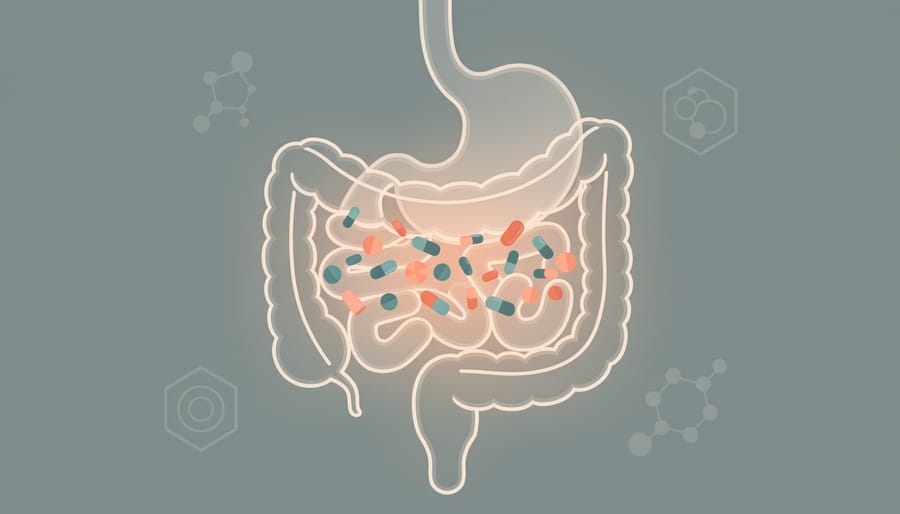
Why Natural Hormones Needed a Redesign
Natural GLP-1 is a bit like a message scribbled on a napkin and tossed into a rushing river. The gut releases it after a meal, it delivers its signal, and then enzymes in the body break it down within a couple of minutes. That’s wonderful for a body managing its own meals, but it’s a real problem if you want to use the hormone as a medicine.
Imagine needing an injection every few minutes just to keep the signal going. Nobody could live that way. So researchers asked a practical question: could they tweak the molecule so those enzymes couldn’t chew through it so quickly, and so it could linger in the bloodstream?
By changing parts of the peptide’s structure and helping it travel attached to proteins in the blood, scientists stretched its working life from minutes to days. That’s why a single weekly injection became the goal: it’s easier to remember, easier to live with, and much closer to how people actually plan their weeks.
The First Single-Target Medicines
The first medicines built from this gut-hormone discovery had a single target: the GLP-1 receptor. Scientists call them GLP-1 receptor agonists, which simply means they press that one “lock” and trigger the body’s natural response. Because they were redesigned to last far longer than the hormone your own gut makes, some could be taken once a day, and later versions just once a week.
These medicines were first developed and approved for type 2 diabetes, where they help the body manage blood sugar after meals. Later, versions studied at higher doses became available for chronic weight management, always under a doctor’s care.
Picture a kitchen with one very reliable cook. The dish comes out well, and people noticed something interesting along the way: many users also felt less hungry and tended to lose weight. That raised a natural question across the research world. If one signal could do this much, could pressing more than one lock at a time do even more? That curiosity pushed scientists toward the next chapter.
From One Target to Two, Then Three: How the Idea Grew
Once single-target medicines proved their worth, researchers started asking a natural question: if one signal helps, could two or three do more? It’s a bit like a family kitchen where one cook handles the whole meal, and then someone suggests bringing in a second pair of hands, and later a third.
The first step was the single agonists, the GLP-1 medicines described earlier. They pressed one lock on the body’s hormonal system and showed that this single signal could meaningfully affect appetite and blood sugar. That success left scientists curious about what the other hormone signals from the gut might add.
The next step was the dual agonists. These add GIP, another gut hormone released after eating, to the GLP-1 signal in a single molecule. A well-known example is tirzepatide, which targets both receptors. The thinking was that GIP might complement GLP-1 in how the body handles blood sugar and responds to food, though researchers are still working out exactly how much each signal contributes.
Then came the idea of a third target. Triple agonists, which is where retatrutide sits, add the glucagon receptor to the GLP-1 and GIP signals. Glucagon is best known as a hormone that helps the body release stored energy, and it is also thought to be involved in how the body uses energy. Researchers wondered whether adding it could contribute something the first two signals did not.
In plain terms, the reasoning goes like this:
– GLP-1: associated with appetite regulation and blood sugar handling
– GIP: thought to work alongside GLP-1 in how the body processes food
– Glucagon: associated with energy use
It helps to remember that this is a scientific hypothesis, not a settled conclusion. Each added signal is being tested in clinical studies to see what it really does, how it balances against the others, and what trade-offs it brings. Think of it as a recipe still being refined: the ingredients are promising, but the tasting is not finished.

How Retatrutide Works: Three Signals in One Molecule

The Three Receptors, One at a Time
Think of each receptor as its own lock on a different door in the body. Retatrutide is designed to fit all three, so it is worth meeting them one at a time:
- GLP-1 receptor: helps signal fullness after eating and supports the body’s natural handling of blood sugar.
- GIP receptor: responds to another gut hormone released with meals and is thought to work alongside GLP-1 in managing appetite and blood sugar.
- Glucagon receptor: is linked to how the body uses stored energy, which is why it is the most surprising addition to the trio.
That glucagon piece deserves a little patience. For years it was seen mainly as the hormone that raises blood sugar, so adding it to a medicine sounded almost backwards. Researchers became interested because glucagon signalling also appears to influence energy use, and pairing it with the other two signals might balance things out.
It is a bit like how one family recipe can be tweaked by three different aunties, each adding a pinch of something that changes the whole pot. Whether this particular combination works as hoped is exactly what clinical studies are still examining.
Why Researchers Think the Combination Matters
Scientists didn’t pair these three signals by accident. The thinking goes that each one nudges the body in a slightly different direction, so together they might do more than any single signal could. GLP-1 is linked to feeling full and to steadier blood sugar. GIP seems to support how the body handles sugar and fat. Glucagon, the least intuitive of the three, may increase how much energy the body burns.
It’s a bit like cooking a pot of canh: sour, salty and sweet all matter, and the balance is what makes it work.
Still, this is a hypothesis being tested, not a settled answer. Researchers are still asking which receptor contributes what, how long the effects last, and whether the benefits outweigh the side effects for different people. Larger and longer studies are how those questions get answered, so careful curiosity is the right posture for now.
Where Retatrutide and Its Relatives Are Used and Studied Today
Walk into a pharmacy in Toronto or Ho Chi Minh City and the shelves tell different stories, because medicines are approved country by country. The same is true for this whole family of peptides, so it helps to separate what is established from what is still being studied.
The older members are now ordinary parts of medical care. GLP-1 medicines and the dual agonist tirzepatide are prescribed for type 2 diabetes and for chronic weight management. A doctor decides who might benefit, checks for other health conditions, and follows up over time. That medical supervision is the point, not a formality.
Retatrutide sits in a different category. It has been studied in clinical trials, which are carefully controlled studies, for conditions related to weight and metabolic health, including type 2 diabetes and obesity. Researchers are also looking at related questions, such as how it affects the liver and other markers of metabolic health. Being studied is not the same as being approved for everyday use.
Please don’t assume its current approval status. The research behind this article doesn’t confirm where retatrutide stands today, and that status can change. For an up-to-date answer, check with Health Canada, Vietnam’s Ministry of Health, or your own physician. Regulatory status can also differ between the two countries. A medicine that is available in one place may still be under review in the other, much like a favourite snack that is sold in Vancouver but impossible to find in Hanoi, or the reverse.
One more caution, offered kindly. Because interest is so high, many unregulated online sellers advertise products labelled with this name. These aren’t checked for purity, dose or safety, and they may contain something other than what the label says. If you are curious about treatment, a conversation with a licensed doctor is the safest first step.
Why This Conversation Matters in Vietnamese-Canadian Communities

In many Vietnamese-Canadian families, health talk rarely happens in a clinic first. It happens over a shared meal. A grandmother might nudge an extra spoonful of canh toward you and remind you to eat well, while a cousin who just read a health headline waits for a pause in the conversation. Those moments are where new medical ideas, including peptide medicines like retatrutide, often first reach a family.
I’ve watched this unfold myself. A news story about a new weight and blood sugar medicine lands in a family group chat in Toronto, gets forwarded to an aunt in Hanoi, and by the weekend it’s being debated at a community gathering over tea. Someone always asks, “Is it real? Is it for us?” Even simple phrases, the kind you pick up from basic Vietnamese words, can help bridge generations when explaining unfamiliar medical terms.
It’s worth remembering how varied these households are. Some cook Vietnamese dishes daily, others rarely do, and food habits shift with region, age, budget and health needs. Even the rhythm of a year, from Tet timing to ordinary weeknights, shapes how families gather and talk. Many Vietnam traditions centre on caring for one another, and that care is best expressed by listening.
Health choices are personal. Curiosity is welcome, but the right next step is a conversation with a trusted doctor who knows your circumstances.
Common Questions About Retatrutide and Multi-Agonist Peptides
What does “multi-agonist” mean?
It describes a single medicine designed to activate more than one hormone receptor at the same time. Think of one key made to turn several locks, rather than carrying a separate key for each.
How is retatrutide different from earlier GLP-1 medicines?
Earlier GLP-1 medicines target one receptor, and dual agonists like tirzepatide target two. Retatrutide is designed to act on three: GLP-1, GIP and glucagon.
Is retatrutide approved for general use?
It has been described as an investigational medicine, and approval status can change and can differ from country to country. Check with Health Canada, Vietnam’s Ministry of Health or your own doctor for the latest word.
Why is it given as a weekly injection?
Natural gut hormones break down within minutes, so researchers designed longer-lasting versions that stay active in the body for days. That is what makes a once-weekly schedule possible in studies.
Where can you find reliable information? Start with your family doctor or pharmacist, who can explain how any medicine fits your own situation. Government health authorities, such as Health Canada and Vietnam’s Ministry of Health, publish regulatory updates, and that is a far safer habit than trusting a viral post or an online seller who promises quick results.
It’s also worth remembering that a new medicine in the headlines is only one piece of a much bigger picture. Everyday health choices still matter just as much, from what we put on the family table to how we move, rest and look after one another. I often think of my aunt’s rule of thumb at the dinner table: before adding anything new, ask a trusted person who knows you well. That advice works just as nicely for the science news that keeps appearing in our group chats.
The story of retatrutide really begins at the dinner table, with the simple fact that our guts send messages after we eat. From that first discovery came GLP-1, then longer-lasting medicines built on it, then dual agonists that added a second signal, and now triple agonists like retatrutide, which are still being studied. Each step grew from the last, and each one asked the same patient question: what if more than one signal could work together?
That’s why the story matters. It reminds us that science rarely leaps; it simmers, much like a pot of phở broth that gets its depth from hours of slow, careful attention.
So stay curious, lean on trusted sources like Health Canada or your own doctor, and keep the conversation going. Some of the best health talks I’ve had happened over a shared meal, with grandparents, cousins and friends all passing dishes and swapping questions around the same table.